Government road repairs fall to six-year low as funding cuts bite
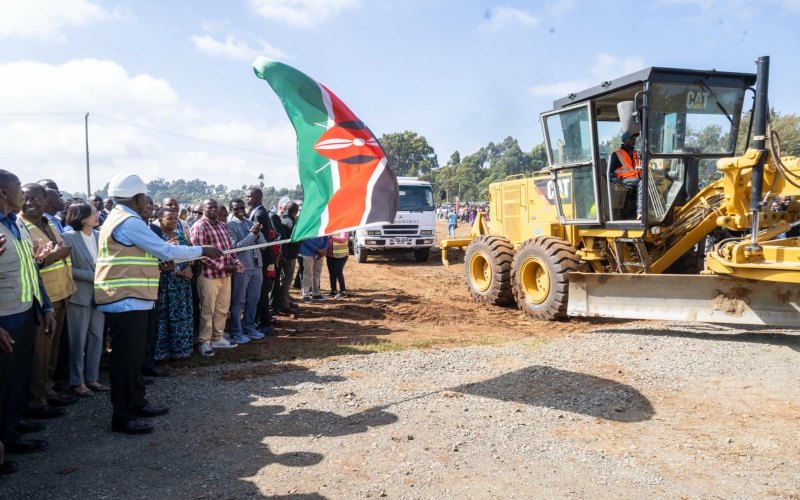
For the first time in almost a decade, road construction and maintenance agencies failed to hit their performance benchmarks, missing the target by 5,148 kilometres, a distance roughly equivalent to more than circling Kenya’s borders.
Repaired roads by the government have fallen to the lowest level in six years, with only 35,965 kilometres fixed in the year to June 2025.
A report by the Department for Roads shows the decline was triggered by cuts to the Road Maintenance Levy Fund (RMLF), which left key agencies unable to meet their annual targets.
More To Read
- Motorist association warns Rironi–Nakuru–Mau Summit Highway expansion to benefit foreign firms, burden taxpayers
- MPs halt Sh2 billion Greenpark underpass over poor design, inaccessible features
- MPs slam road agencies over billions spent on poorly maintained roads
- Counties to receive direct funding for road maintenance after passage of new Bill
- Showdown looms as counties, MPs clash over Road Maintenance Levy Fund
- CS Chirchir defends Sh175 billion infrastructure bond, assures it won’t raise public debt
For the first time in almost a decade, road construction and maintenance agencies failed to hit their performance benchmarks, missing the target by 5,148 kilometres, a distance roughly equivalent to more than circling Kenya’s borders.
According to the department’s performance assessment for the year ended June 2025, the setback followed a reduction in the RMLF allocations, after the state diverted part of the levy for administrative use and to secure new loans.
“Target [was] not achieved due to reduction in RMLF budget during implementation,” reads the report.
The drop comes in sharp contrast to the previous year, when agencies surpassed their targets by repairing 50,094 kilometres against a target of 43,532 kilometres, supported by stable RMLF funding.
Records from the Kenya Roads Board (KRB), which manages the levy, show that allocations to the three main agencies, the Kenya National Highways Authority (KeNHA), Kenya Urban Roads Authority (KURA) and the Kenya Rural Roads Authority (KeRRA), all fell after part of the fund was redirected.
KeNHA, responsible for major roads and highways, recorded the biggest cut, with its allocation dropping from Sh20.6 billion to Sh16.8 billion, an 18 per cent decline, even though it was still expected to maintain nearly the same road length. KeRRA’s allocation fell by Sh1 billion to Sh18.1 billion, while KURA’s allocation declined by Sh2.4 billion to Sh6.6 billion.
Kenya Wildlife Service, which maintains road networks within national parks and game reserves, also saw its allocation trimmed by Sh60.8 million to Sh639 million.
The Road Maintenance Levy itself is a fuel-based charge imposed on every litre of petrol and diesel sold across the country. Set at Sh25 per litre, the levy is collected by the Kenya Revenue Authority and ring-fenced specifically for maintaining and rehabilitating public roads nationwide.
Funds raised through the levy flow into the Road Maintenance Levy Fund, which is overseen by KRB. The board allocates resources to national road agencies, primarily KeNHA for national highways, KURA for urban roads and KeRRA for rural networks, based on annual work plans and technical assessments. County governments do not receive direct allocations from the fund.
Established through an act of parliament in 1993, the levy has long served as a critical pillar of road financing, supporting both maintenance and development of transport networks. Over the years, it has reinforced economic activity by improving access, lowering transport costs and enhancing safety on the roads.
For example, through KeRRA’s oversight, rural access roads have been improved, enabling farmers to reach markets more easily and boosting local trade. KeRRA also notes that the levy has supported regular maintenance programmes aligned with national development goals, contributing to smoother transport, reduced travel time and progress toward the Sustainable Development Goals.
Top Stories Today